
Why can't we have TOD?
There was a time when transit-oriented development (TOD) was automatic. Now it's like pushing string.

It’s the Feedback
This series of articles has repeatedly stated that the urban ecology of transit-oriented development (TOD) ended bout 1920. It was replaced by auto-oriented sprawl (AOS). The assertion is elaborated in the book-length Limits to Mobility (LTM) and Urban Rail and Troy.
And yet…we hear frequently today about aspirations and projects for TOD wherever a symbiosis of urban density and transit can be achieved. Or, look at the few cities where rail transit still exists and is that not TOD? I worked for one of those, at the Cleveland Regional Transit Authority. So whaddaya mean TOD is dead? I mean that despite transit investment (the Cleveland Waterfront line for one) the central city and even county were still losing population and commerce.
I mean the difference between a self-organizing TOD as the dominate mode of urban development and TOD as some happenstance conjunction of State policy contra the dominant sprawl development and with a tiny flow of transport investment compared to highways. In short, TOD was once how our spatial economy worked, and now is made into a fractious political issue accused of inefficient “subsidy” against “what people want”.
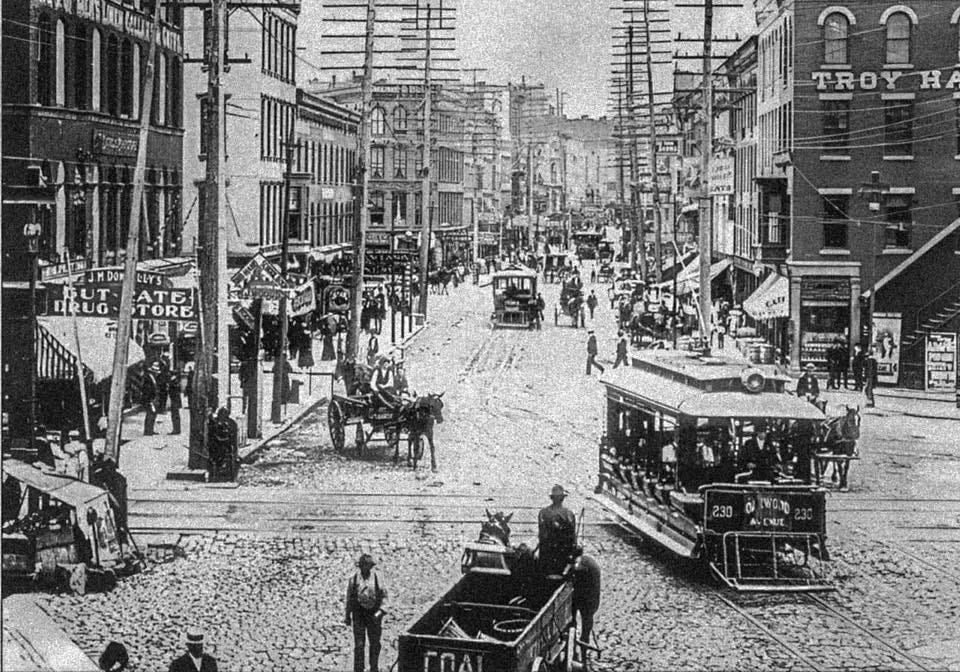
Downtown Troy, NY, 1890’s. The Oakwood trolley line in right foreground was first to be discontinued in 1925. Troy as a central business district was discontinued in 1973 shortly after all private bus operations were discontinued. Photo via John Bulmer.
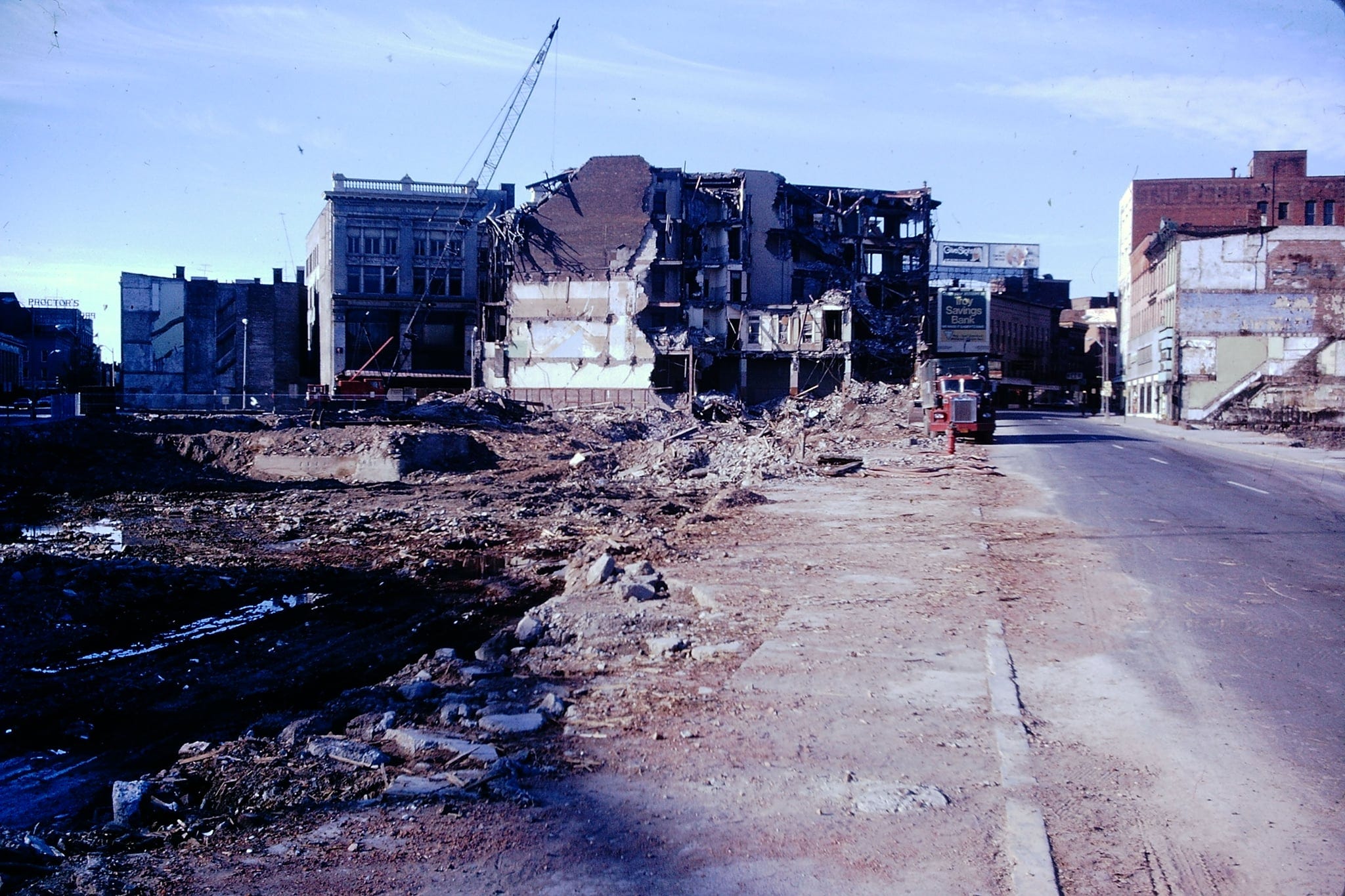
Looking at the same area in Troy, 1973. No trolleys, the railroad station gone in 1958 and an Interstate freeway running across the Hudson River and coming over an 8-lane bridge to “save” the downtown. John Gernon photo.
The important difference is in the form of our behavior, how we choose to move and locate. We always do what is “best under the circumstances”, and a change in “circumstance” is what is meant by the TOD → AOS urban form. “What people want” has no meaning apart from the form they are behaving in. The form changed, right around 1920 when the State (our government hierarchy) decided to ignore the rail network of TOD and replace it with a free highway system. These were purposeful actions to ignore the plight of rail finance, failure to retain the mainline rail system that was nationalized in WW I and instead pursue an expensive national highway system. There was never any accountability for the urban form, since somehow that just took care of itself by “local” decisions in the “market” economy. But it was just that self-organization the State had just destroyed by a dual misuse of State power.
A tutorial on self-organizing systems (SOS) is in LTM Part I. Oh, let’s ignore that systems theory and instead go along in our ideological confusion about how we choose, what we have to choose from, and how we manage our common ecology.
Systems theory and SOS are based on feedbacks. Feedbacks are loops such as A causes B, causes C causes A. The highway program, traffic and sprawl are in such a loop. The loop confuses causation and accountability. We have been arguing about “who causes sprawl” ever since. To blame “what people want” is how our levels of civic management avoid any accountability. But they decide who and what they pull money out of (originally the TOD centers and the asset-rich railroads) and what it goes to. They decide what to regulate and preserve, or ignore even when that has vital effect.
Change the loop, such as rail→density→rail traffic→rail service… to auto→density destruction→auto traffic→highways…and a formal change has been made. Our behavior is just one link in that loop but what we do either gets reinforced (positive feedback) or suppressed (negative feedback). After 1920 (the peak of rail extent for mainline and urban trolleys) the feedback was positive for AOS and negative for TOD. The formal change takes more than our behavior given a feedback form. The formal change can be unintentional and unnoticed when some threshold is crossed (that is catastrophe theory). And when the change happens it has only small effect but exponentiates (compound growth) over a long time.
Automobiles in the US date to about 1893 that starts exponential growth (positive feedback) such that the auto population doubled every 2 years between 1900 and 1918. Are there limits to growth? Sure. The TOD city limited parking and rail investment was not highway investment. Once the automobile got its camel’s nose into the downtown “carriage trade” the merchants started agitating to tear down housing, stores and tax base for parking. This is by itself a Tragedy of the Commons (TOTC) still going on in my time. The Chamber of Commerce was its own worst enemy. That resulted in the second picture above, that mostly became a parking garage that itself was torn down a couple of years ago. The once TOD center of rail access disappeared. That much was just local mismanagement but promoted by all that State money for “urban renewal” however much opposed by my young self and many others. See Joe Fama’s nice article on that project.
Highways are the State-created link beyond the local. How can the cars get to the erstwhile centers? First they needed the rural Good Roads program, begun about 1893. By 1939 the Federal highway agency had decided that the TOD was obsolete and the centers had to be torn down for the automobile. That was just the Federal level conforming to the loop already established. What, me accountable? “We are just serving the traffic we predict.”
Abundance versus Efficiency and Equity
There is a current debate about “Abundance” or “supply-side progressivism”. The postures on this are discussed in a nice review [Clayton Nall, What’s Missing From Supply-Side Progressivism?, JAPA, 2025]. I detect a “why can’t we build like we used to” version of MAGA but on behalf of Democrats. Perhaps there is a craving for the Democrats who were also the initiators of the iconic Interstate freeway project even if that was supercharged by Republican Eisenhower but continued by other Democrats against its peak opposition. JFK was seen as a potential doubter of the project but in any case between JFK and LBJ we got a Fatal Federal Fragmentation of urban programs. The highway building and urban demolition was just great. Is that what we want to be more Abundant?
I do not want to add more blather to the thesis that More is the answer to the apparent inequity and unaffordability to about half of the “middle class”. The stance of LTM is against top-down projects in the same way Jane Jacobs was against “cataclysmic money”. The basic principle should be that the government hierarchy is responsible for risk and equity, but building our urban ecology should be bottom-up as it was in the TOD. We should have cities in which the development and transport fits. The urban form is all important but the inequity in the capitalist system is a matter of regulation and redistribution that is a hierarchical function.
What can go wrong with a naive “abundance”—that at worst is Trump’s inequity and deregulation—is already in the history of the TOD. Regulation of the transport component of access went haywire. In the AOS the substitution of investment in an auto (part of the current unaffordability) for a transit fare only increased inequity. Behind that was the “abundance” of urban space consumption that is just another dimension of inequity. The Federal “housing program” (after the Housing Act of 1949) was a racially and income-biased promotion of suburban sprawl and demolition of urban neighborhoods in partnership with the highway program. Is that what we are supposed to replicate?
The TOD by no means was lacking economic and racial inequity. Those were yet to be solved but equity is the criterion, not efficiency of consuming urban space by mobility. The great project after 1920 would have been reinvestment in urban housing that was already there in the TOD or could be expanded by the same feedback of transit and development that had occurred up to 1920.
Instead, the consumption of urban space stretches all infrastructure and its finance is inherently inequitable. The infrastructure and development that exists always supports the increasing costs of spatially extending utilities and transport. The net result has been the “decaying infrastructure” and an excess of demand restated as lack of capacity: Needs a Project not Regulation!
Abundance is the “all boats float” in liberal clothing. The necessary criteria of risk regulation and equity might also be mentioned but none of the debate can ignore the urban form that has to do with those criteria as well as the efficiency of what we build in terms of affordability, the ecology and the inequity of dosage-risk exposure.
What is to be Done?
LTM argues that anything we make into a “crisis” today is a magnification of what the TOD faced in 1920. The New Deal was the first major confrontation with the outcomes and even the 1960’s were a wake-up—especially to the inequity created by transit contraction—and in both cases the responses missed the essential issue: The State failed to preserve our ecological form and rather promoted its collapse into the AOS.
Every current effort at TOD fails to alter the formal feedbacks that destroyed the TOD when it was the dominant self-organization of our urban-industrial ecology. Part of my career was engaged in the projects that tried to preserve, even extend, the transit we have. Yet it was always an inefficient trickle of public funding against the stream of auto-oriented investment entrained by the AOS loop. We simply increase the total inefficiency of the urban ecology (at the expense of whatever else is in our space). The “environmental activist” part of my career just showed that the dichotomy of “nature” and urban was active, as it is in the State projects. We are just dedicated to consuming space that ignores what was developed while trampling what is not yet “developed”.
TOD as an aspiration is valid. In some cities it does exist. Cities implementing the regulation of decongestion pricing on auto traffic are making the first move toward a feedback form that TOD had.
The regulation of development (including housing) expansion needs spatial-form regulation. But that has to recognize the urban form and dynamics that LTM tries to be a tutorial on. The steep gradient (centralized density with centralized tail access) must be promoted by the location-transport feedback the TOD had. But the central-place network must also be recognized. We are not building new urban centers. Yes there are a few “new towns” and Reston, with which I am quite familiar is a good example of a vision out of phase with the AOS.
The major defect a neo-TOD has to contend with is the political implication of sprawl. In part that is our polarization that fuels State preemption of any TOD. But that also exposes the fact that accountability for development has diffused far beyond the original settlement and jurisdictional bounds. Troy was its own place and jurisdiction to about 1920: It was the market center of a wide area but that economic relation in the TOD follows the TOD access form. Yes you could “move out” and displace some farmland but the transport system centered on the core was its own “tax” on any such spatial extension. And that “tax” went into rail investment despite public tax burdens on the rail enterprise. As long as the tax and development jurisdiction were more or less the same area the TOD survived.
After 1920 and continuing in my time, all I see is jurisdictional competition for development (tax base) that is completely biased by the highway-construction feedback. The AOS drains the old central business districts for sprawl commerce, and congestion of the once inter-city arterials. Answer: Freeways! Not regulating “strip development”, a thought that passed in 1939.
This failure of regional governance is, of course, because there is no regional governance but rather a vacuum filled by State projects and jurisdictional exploitation. This is a basic constitutional defect.
Making the urban functional region, more or less the Census-defined MSA a jurisdiction would make a proper mapping of governance to ecological module. The criteria of accountability for risk and equity have to apply, just as they do faultily to the current levels of the State. But many problems of preemption, urban-bias and inequity would be solvable.
Is this a realistic prescription? It is a prescription to fix a constitutional defect and, by the way, have a chance at restoring TOD feedbacks. I just happen to think it is a necessary condition. Without it, let’s just realize there is no more TOD, only some relicts and inefficient investments with high ecological risk and continuing inequity. Because the State does not care about urban form, ecological risk or human equity.