

The Good Roads Movement
How did we get to be a country that keeps chasing auto traffic with highways and ignores rail?
Limits to Mobility (LTM) pondered this issue over 50 years and came to the conclusion that the answer lies back in policy decisions made between 1893 and 1920. In other words we created the dilemma over a century of policy that lost control of itself and was controlled by auto traffic. Recently we are facing the same problem of unregulated technology with AI. The history is relevant—but can we learn from it?
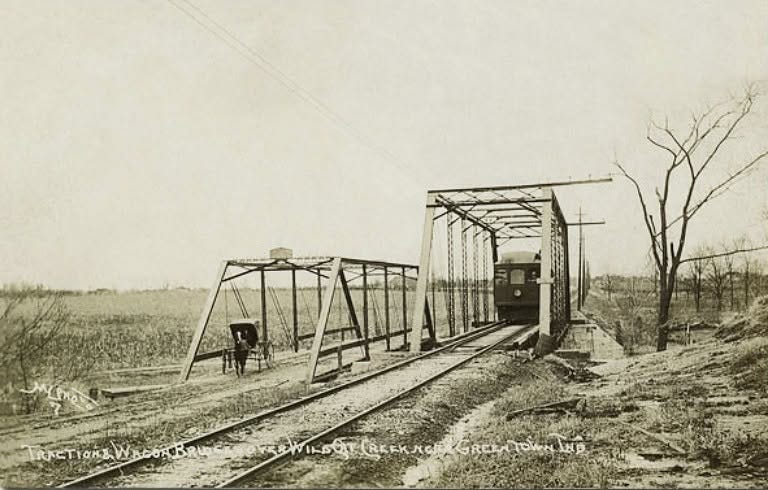
Image ca. 1903, Green Town IN. What gets you there better, the rail or the carriage?
Readers here will have heard versions of this LTM story in several articles, especially Take Me Home Country Roads. However I was incensed recently by a learned book that could not take the story back past 1956. That totally misses the original accountability in the Federal and State governments for a program that destroyed transit-oriented development (TOD) and put our money and cities into auto-oriented sprawl (AOS). Indeed there is much ignorance and argument about that formal change in our urban ecology, and so the causal allocation of all our behavior. We arrive at the present when we we think we have no choice.
Individual choice versus social outcome is the issue. There is a gap between what we can choose individually—that is always “under the circumstance”—and what we produce collectively as “the circumstance” including how our government works.
Yet there is variety, the soul of democracy. I am quite aware there is still some TOD. Indeed I lived in the DC area for 27 years and almost never did the work commute by automobile. Needed it only to get to the sprawl outside the Beltway. But, working near Tysons Corner it also became increasingly impossible to walk anywhere, so not true TOD even well inside the Beltway.
I am also aware that 5% or so of commuters use transit in the US and similar numbers bike or walk (occasionally ski or skate). Even that varies greatly as shown in a wonderful display that maps modal use against, among other things, the party vote of counties [TRANSPORT DATABOOK]. Transit share of commutes goes from near 0 to 50% across US counties.
I have always been aberrant in my travel behavior (including bike commuting in DC) and so my behavior has no political sway: I was told so by my Congressman once. There are others who also rail (sic) against the national situation we are in [Kea Wilson, Study: Americans Already Doubt the Myth that ‘Driving is Freedom’...and most of them want real freedom to choose how they get around, too. StreetsblogUSA, October 14, 2026].
Why are there not enough of us to change policy back to what we know worked in the TOD a century ago? Why is there a belief that we can “solve” congestion by more capacity for more auto traffic? Of course that is not the problem in the hinterlands where the net flow of transport money goes. And that contra-urban flow is and has been the problem. Not that the “country” should go unattended in roads, telephone service or electrification. But why has that been our “equity” policy indifferent to what was happening to urban transit and urban form?
Follow the money. I did in a study of total transport funding in New York State in the 1970’s, accounting for the money to-from each urban region and the remaining non-metro area in New York State. Result: All modal money flowed out of the larger metros to everywhere else with the non-metro being the big “subsidy” winner. But hardly anyone perceives it that way. The “City” gets all our tax money! One of the lies that turns the countryside “Red”. But if less gummint programs hurt the countryside more that is just another example of our social perversity.
The big urban regions that still have rail transit are toward the high end of transit commuting, of course. The same regions lack their own governance jurisdiction. Transit authorities—like the one I worked for in Cleveland—can only appeal to a divided jurisdiction for money. Meanwhile the State (combined Federal and several) suck money out of cities, put it in a blender and spew it out in funding way biased to highways and their expansion according to auto traffic (and the 1% or so of bus vehicles on them).
I keep pointing out that our political polarity is correlated with urban density which is a current reason for policy bias against transit and for petro-gobbling at any price. Take that back and century and we can glimpse where the bias comes from: The fact that US space is so big and cities so small.
It’s Access, stupid.
The picture (above) of the carriage and the interurban trolley is intended to take us back to that critical period around 1900. The automobile and the Federal/State highway program began its exponential growth about 1893. 1905 was about the inflection in rail exponential growth that peaked in 1920 (lots of data in Urban Rail and Troy).
1920 was critical because it was maximum instability in the rail industry and Federal/State policy was indifferent to that as it was to the economy generally until the New Deal. The “market economy” was relied on except for monopolies, financial instabilities and the fact that the urban ecology was a public good, not a market good.
In any case the market ideology was violated when a national highway system was posed and put into 1921 Federal legislation. That was the critical change in the dynamics of urban form and the government is fully accountable for violated how the urban ecology had evolved. But “they” (politicians) never saw it that way and the individual losers of rail options—and eventually the losers of the TOD city—just were caught in the “circumstance”. Helpless, impotent. Get on the bus and watch the bus service contract until it had to be “subsidized” everywhere after 1970. Oh, just in time for the “gas crisis” in 1973. Policy change then? Not much, for that shrinking 5% of transit users. Why should We subsidize Them? Let us rather bet on on more petroleum pumping, however fragile and damaging that is. The lack of foresight was proved well enough around 1920.
LTM is about the accountability and the formal change in the feedback of urban access that happened in 1920. It was another 24 years before the other shoe dropped of planning freeways through cities. Then another 12 years (to 1956) to when all you young people think this auto-highway loop started. Nope. Sorry, you need better history and poli-sci.
The high-level (State) accountability should have been for urban form, the geography that is the unchosen “circumstance” of all our behavior including diddly use of transit and the exponential growth of vehicle miles traveled (VMT). Lots of people killed in auto crashes along the way, but hey that is the price of unaccountability.
Urban form is a scalar field of density at every 2-dimensional point on our surface space. I leave Lunar and Martian form to attend to later (but start worrying now). From that spatial scalar field an access measure can be calculated at each point. That is the “circumstance” for each person at each point trying to connect to other points. But zoom out. The “public” issue, the issue that government should attend to, is the access pattern over space. We see that, myopically, as places in discrete areas, or a spread of unincorporated space. We can only generalize urban forms—the TOD or AOS—as a general clustering or not of density and the old lively downtowns, or their relics. One may notice that over time the change of form was accompanied by the retraction of rail, the loss of the train station downtown, the tearing up of the trolley tracks. Cause or effect? Chicken and egg? That is what confuses us, and politicians use as an excuse.
This causal confusion has been convenient for political unaccountability: “We just serve growing auto traffic! It is what people want!”.
All along, since 1893 (a little earlier for some States) the government got into road projects and took no accountability for “land use” or the rest of the ecology. That was too complex. Only in the 1960’s was there some attention to “social, economic and environmental impacts” because the ecological damage was already apparent. It just happens I got into highway and “urban renewal” fighting shortly after and can vouch that no part of the highway program was significantly affected. The freeways had to be “finished”. Then they had to be restored (decaying infrastructure!) and then expanded. We got a powerful, government-directed money flow to keep the AOS going. Or (chicken-egg) the AOS kept the State program going. Memory of TOD was lost and there was no one to care about urban form. Perhaps the most local jurisdictions cared but they were as much in the “circumstances” as individuals. The economic dynamic for access was “sprawl and crawl”. No one accountable, no one in charge. But there has been talk, by the few, the dissenters, the aberrant. And they are losing the memory of just what the formal issue is.
Way Back When
The interurban and carriage image is just a prompt to make you imagine what the “circumstance” was in the critical years and what could have done at the formal level occupied by the upper levels of government (collectively “the State”).
If you lived in any place at all, there was a rail connection to other places. There was even fun in the synthetic places of “trolley parks”. Some of those were Luna Parks because they were so lit up by the electric companies running the trolleys. Reciprocally (see the chicken-egg or feedback loop?) you would locate where you lived and worked in one of the rail-accessible places. Location served transit and transit served location. Get it? No one chose that loop, but it emerged from the technology, finance and human behavior.
But wait, why is that dude in the horse carriage on that crummy road going so much slower than the train? What aberrant person chooses to do that?
It’s access, stupid. If you start in a place without rail access and want to go to another such place, you are in a circumstance where rail is no choice. OK, get a horse! Invest in the animal, its feed, its manure, and the carriage because you have no choice. Rather pay a nickel (or 15 cents etc.) for a trip when you need it? Hmmmm….let me do the numbers. Yup, train would be nice.
If wants were horses then we would all be on one. If wants were auto traffic that congests itself we would be in traffic congestion. Oh wait…is that what we chose? Nope, none of this is about individual wants and choices.
What we get ca. 1893 are two opposing economies (literally how we manage the ecology). One is rail-corporate and its finance. You grow and investors get you money to grow. Feedback! The other is “the farmer”. Needs space, spreads over space and faces the tradeoff of space for urban access. Always at the access fringe. Get a horse! Travel to the market center once a week or so. It all works out. It is all economics of the “invisible hand” unsullied by State Planning (like those Commies).
But the peasants revolt and that becomes the Good Roads movement after the Civil War. That was about the time the frontier closes. Hmmmm…we spread out onto all that land that was so cheap. Now we turn around and want to make money by accessing the urban market. Its all about urban access, stupid.
I am for social equity to be achieved by State cash transfers. That is what the State hierarchy is for besides protecting the space in which we can do economics. Farmer got no electricity or telephone or health service? I am for getting them some. Crummy roads? Sorry, that is free economics. Start messing with that and pretty soon you are up to your neck not in mud but the muddle of traffic and more an more taxes for more and more inefficient roads.
But then the State redistribution to the rural parts thought “Good Roads” right around 1890 when the frontier closed. It is all about space and the access form. But now State attention has shrink from the national-space level to the urban access form. Cities got rail, country has crummy roads. Oh please Mister State give us the money we do not have.
Wha? Sounds like socialism to me. Like I say I am not against that when it helps people. But when that gets beyond helping people to a huge gummint program to rival those nasty rail corporations, I start asking about the economics and who is accountable at the formal level of governance. Who is accountable for sucking tax money out of the cities (and rail) to spread over the countryside? And what happens when that road-money flow is expropriated by the rich auto owners instead of the poor farmers?
That is the part they cut out of the movie. Notice what is missing? Nope. Almost everyone alive now thinks urban access and transport policy starts in 1956 and for those cool Chevies. Many do not even remember about 1939 when the Federal policy to put freeways through cities was fully articulated after some decades of highway-building development. What might have seemed really stooopid about 1910 was now just a “natural”, even “free market” response to auto traffic. What people want! You just have to add an anti-urban bias.
Don’t know much about History
I have made the case that current policy is based on a trap and ignorance. LTM has put the space-biased politics together with systems theory applied to the urban form. What happened becomes self-evident if studied. There is nothing inevitable about current policy but it suffers from unaccountability of what policy has done, cannot learn and just continues to make the hole deeper. It takes away choice from us. The politicians are caught in their own loop of money to get elected to have power to get money. That is the political form of the traffic-capacity loop. We are all caught in the wheel. Very Buddhist.
So back to my initial fuming about people who think this starts in 1956. It does not. It takes more time to get stuck in such a form where we think there is no choice.
But history does not roll backwards either like a tape measure. AOS is now as powerful as all the money flows in it to corporations and politicians. We in systems call it hysteresis: Going back is not the same as going forward.
If you might think TOD and NOT subsidizing congestion is a good policy, then it is necessary to change the form of politics before urban form can be change. Follow the money. But government should be about our urban form, stupid.
My point was that in the TOD the "where" and the "mode" are tied in a particular feedback. That is what changed at what I call the Formal (circumstance) level that is above any particular "where" and "mode" situation.
"What gets you there better?" It depends on where you came from and where you are going, and how that relates to the service characteristics of the railroad in question.