
Toothpaste back into the Tube
Undoing an Interstate highway and the problem of getting transit-oriented development (TOD) back

Roll up the pavement, Un-draw the lines
I read a critique on the analysis for un-doing I-94 in Minneapolis/St. Paul [Tuomas Sivula, Overthinking I-94: Traffic jam (Part 3/4), Streets MN, March 23, 2026]. The project is described by MNDOT [Preliminary Traffic and Transit Analysis of Alternatives, April, 2025]:
“Rethinking I-94 is identifying and understanding potential alternatives for a 7.5-mile segment between downtown Minneapolis and downtown St. Paul. Currently, the project is in Phase 2 – Environmental Process.”
This un-project is an instance of several others. Close to me is the Syracuse un-doing of I-81 [I-81 Viaduct Project]. Just across the Hudson River from Troy un-doing I-787 in downtown Albany is being considered [Re-Imagining I-787]. A successful un-project was the removal of Embarcadero elevated highway from the San Francisco waterfront. That highway was one of the classic cases of dissent in the 1950’s Why couldn’t we just cut out the expensive mistake that was first made in the first place? It would have been so easy. At the time funding the highway seemed necessary, efficient for auto traffic, and like rolling downhill. That it why undoing easy mistakes seems like going back uphill.
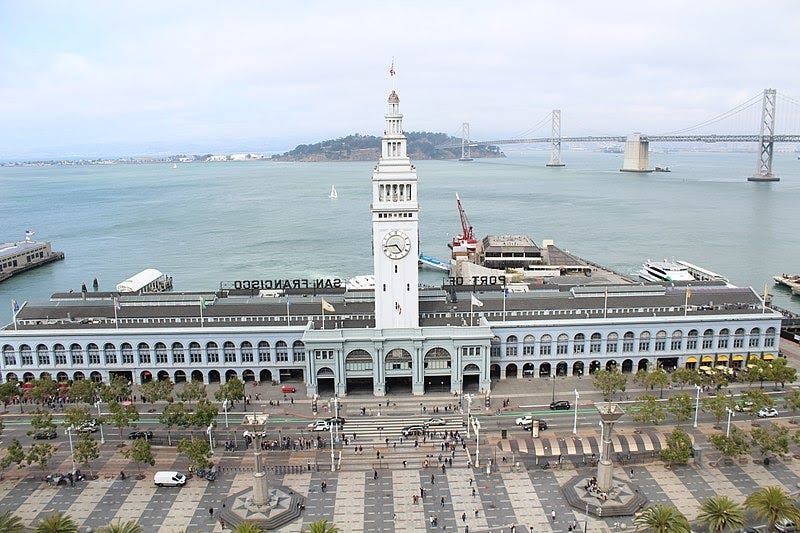
Gone: The freeway blocking the view of the customs terminal on San Francisco bay. Where did the cars go? A half century to undo a mistake.
Or, another metaphor is toothpaste: Squeezing out seems easy but putting it back in is hard. Behind the political decisions (that represent an arbitrary amount of logical work) is the physics of the second law exhibited in hysteresis.
Hysteresis and Formal Change
As a systems engineer, I think of history-reversing as examples of hysteresis. That is usually explained by a diagram such as the one below:
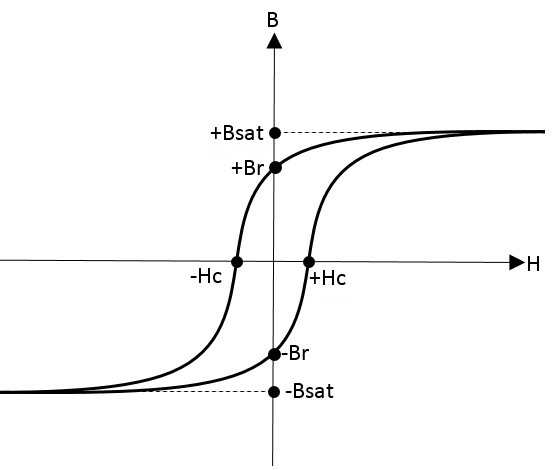
Hysteresis: The asymmetry of change. Image by Insa 4gp groupe ferro - Own work, CC BY-SA 4.0, https://commons.wikimedia.org/w/index.php?curid=39915912
The diagram happens to be about the magnetization of a material as an external field is applied. The classical version is about steam engines. The particular numerical cases are examples of something that contradicts our usual concept of linear or efficient cause-effect.
Hysteresis also contradicts the idea that mathematical functions have unique values. That would be B as a function of H or B = f(H) as labeled above or generally y = f(x), the value of a “dependent” variable y on the change in some manipulated variable x. There could be any kind of function. But elementary algebra and our physical experience misleads us that if y goes up as x does, then taking x back down should bring y to where it was. That is a special case of reversibility that physically occurs for small changes and linearly (y change proportional to x change).
These ideas accord with our fine physical control of moving things around, until we push the glass over the table edge (nonlinear, irreversible). We like to avoid these “catastrophes” in favor of linear relations for variables we manipulate. That expands into correlation functions that take a statistical ensemble of x’s and y’s, as (x, y) pairs. Even when the (x, y) data are “all over the map” linear regression analysis derives unique (x,y) pairs from the single-value function y = f(x). That looks like a deterministic function, but regression only derives a statistic (the function) of the ensemble. It is usually linear because the only practical theory we have for “fitting the regression” assumes linear relations.
The statistical case implies processes that do not provide a unique y for each x. Hysteresis is not that statistical case. However the statistics are a formal (even invariant) representation of the variety that is going on. Similarly the hysteresis function is the form of the (x, y) changes even if there is no unique (x, y) pairing. The hysteresis represents some invariant physics about the physical variables of any real (material) system. That applies to urban ecologies and that will bring us back to transit, highways and toothpaste (as in getting back into the tube).
The diagram above shows that as H is moved to the right, B climbs up through +Hc to reach a peak Bsat (saturation magnetization in this case). Imagine one of those magnetic cranes picking up scrap iron. Apply the current and the magnet gets the “pull” to pick up the load. Go back to the left and does the the magnet follow the same curve (function)? No. It follows the upper curve and comes back through -Hc. Why? Work has been done to magnetize the material and work has to be done to undo the material change. The change is in the orientation of the magnetic domains of the material. Now think of that as how the form of our ecology affects our human behavior, like where we locate, how we connect locations and by what modes of transport. We have been “magnetized” by a century of automobile availability and use.
Tangible work is what the steam engine diagrams are about. Push the piston by steam and have it turn that wheel. Does the piston come back by itself? No. Work has to be done to get back to the original state (small-s, a set of measures of the system) and the space between the curves represents the gone-work applied externally.
Hysteresis means that the relation of y to x depends on the history of x, on which way it is going in time. There is a “path dependence”. History is asymmetric. We know that from physics as the second law. That is just diffusion (hot to cold) interpreted as the dissipation of energy or the increase in entropy.
Transit and Highways
What I want to talk about is the history of our urban form and why the work done to dissipate cities—that was immense and expensive—will not be just a “ride downhill” if we ever try to go back. Logical sense has nothing to do with it. Which suggests the constitutional principle that politicians should not just do what they feel like, or “think good” or, even worse, gets them votes. They like to ride “downhill” by doing nothing unpopular, or against their funding interests. They should preside over invariant ecological forms.
Limits to Mobility (LTM) takes the long view of formal change. It is about the transit-oriented development (TOD) urban form we had and how that was undone about 1920 to give us auto-oriented sprawl (AOS). What happened to the rail transit, and subsequently the bus transit, is detailed in Urban Rail and Troy. Having worked in transit I know how hard it is to get it back [Trying to turn the Transit Tide].
LTM emphasizes the difference between formal and efficient cause. Discussing hysteresis or statistics illustrates that difference between the formal (how change occurs) and the efficient (little actions under or following the form). We talk “choice” but really are slaves to the form of social behavior. That can be good by following rules to get along with each other and the ecology. Or bad in an economy that exploits and avoids accountability for the effects on the ecology.
LTM also emphasizes that the form of change is defined by the feedbacks. We are just behavioral links in these feedback loops.
TOD ended when the form of development changed from a positive feedback between location with transit to the positive feedback of getting out of cities by automobile. You can’t go home again when they took the neighborhood for a freeway.
The financial change for transit can be traced to the early 1900’s and that was merely “efficient”: Every rail operator looked at the books and found costs increasing while revenues at best leveled. They attempted control in what they thought was a linear, unique value y (net revenue) = f(x as costs). Efficiency! Just cut cost! But “under the circumstances” (formal) that became the vicious circle of decline. It does not take much smarts to notice that the financial fiddling assumes ridership staying up, as if that were a formal invariant despite changes in transit service, competing automobile options and then locations.
Ridership is a function of many variables (here comes the regression analysis) some of which are controllable parameters of the service (how much, where and at what fare). That is the efficient-cause domain that the operators (later public transit planners) think they can manipulate with reliable changing-x —> changes-y outcomes. This deals with linear “elasticities” that are single-valued y = f(x) relations that ultimately are statistical correlations from a variety of cases. But the cases may be from quite different times and places, meaning that they are of different formal cause because places and times are different.
The problem of prediction with formal change is the topic I harp on in Prediction needs Regulation. Anyone interested in change would like to stick with small, reliable efficient cause-effect they are used to. Logically, how can there be any prediction from past information unless there is a time-invariant form of the change (that is the predictor). This is also where the statistics come in, as long as no time is materially identical to another. This is not hysteresis, but unless time change is symmetric the future will always be different and that is a limit to prediction of the real ecology. Things change! But the statistical variety within a form (e.g., mode choice and the 5% of weirdos who now use transit) is different from the change of all urban behavior (always efficient!) because of a change of form.
Both transit and highway planners deal with “reliable” algorithms (officially approved!) that stick with small changes and linear, single-valued y = f(x) kinds of models. Formal change is beyond their pay grade. It is “political”.
A footnote here. You may know that highway level of service (LOS) analysis is based on a traffic volume-density-speed relation. That has been discussed in one of these articles and at length in LTM Part III. The volume-density and volume-speed relations have dual values in the congested regime when vehicles interact densely. Maximum volume occurs when vehicles are close-packed but move slowly in this regime where the flow is also unstable (stop and go). This is why LOS practice is to build highway capacity to stay away from the congested regime called LOS E to F. This has the effect of a linear and unique-value for the highway capacity to traffic volume relation when the volume is predicted. The congestion regime is quite variable and the “curves” used in capacity calculations are only statistical regressions on the data scatter. That and the hysteresis in the variables is avoided by “generous” capacity standards that are, however, defeated by induced traffic because of the traffic-volume prediction change of form when traffic bottlenecks are altered. The engineers do not like, or want to consider the formal changes. Nor will they admit that their methods are merely statistical.
I have noted (especially in LTM Part III) that traffic predictors really do not care about past predictions because “things change”. Formal change is everywhere and we ignore it. We ignore hysteresis and the large-scale work on the ecology that is asymmetric in history. Pushing freeways through cities is just pushed along by increasing traffic. Go the other way? How can I get to work without the freeway? How did they in, say, 1905?
Sisyphus pushing the Boulder Uphill
There are a lot of little, efficient efforts to do TOD projects. But there are still a lot of powerful projects for the AOS. Analysts try to show how efficient it is to reduce traffic and commuter costs if people and jobs locate compactly and use rail (less space per trip) to go with the location. Traffic engineers just focus on the efficiency of moving auto traffic. Yup, I am totally convinced about the efficiency but what form are we talking about?
Why is TOD not automatic among all the efficient decisionmakers, and all their behavior, like it was well before 1920? Examine every such behavior—of greenspace development and tripmakers—and you will easily see how they all act efficiently “under the circumstances”. They got there on that “move to the right” curve, as a great public work often against severe dissent over the last century. The current TOD advocates want to move leftward on the other curve. They want to reverse history and put the toothpaste back in the tube.
The myth of Sisyphus is about hysteresis. The Greeks knew the physics of irreversible work. The image of pushing the boulder uphill represents work uphill against the gravity gradient. This is a spatial asymmetry just like higher city density and lower suburban density. It is also the time asymmetry of uphill and downhill phases (Sisyphus’ labor and frustration). The formal cause is the hill and going up is not the same as going down. Could you flatten the hill? Yes, and that is the just the kind of formal cause that flattened the urban density gradient into what we call sprawl. Cities were physically flattened for highways and “urban removal” and that took expensive State (Big-S, the political hierarchy) work. TOD literally goes uphill by truing to rebuild the urban access gradient (high in the city centers).
The exact physical analog is getting strained here, but the point is that making and undoing a form of the ecology—the circumstances we live in—will be asymmetrical and with hysteresis. Can I mention genetic extinctions? Same idea but the backward path may not exist at all. Can we “solve” climate change? Maybe not.
Can we retrieve TOD, or just save urban centers from freeways? Many hope so. I do, but I also know the powerful formal change required. And I do not see politicians at any level willing to abandon their little, efficient functions of “take money from people who exploit the ecology”. You have met Drill Baby, right? So he will frustrate his oil buddies and bring back rail and EVs, right? Formal responsibility: Even to the Constitution? What, me worry? Nobody wants the uphill push. But that is just what dissent against most of State ecological policy is.
I did most of my environmental impact statement (EIS) sharpshooting in the 1970’s. I was most involved in fighting one of the sequellae of I-787, the 8-lane Hoosick Street Bridge into Troy that just had to connect to the Maplewood Cloverleaf and its westward thrust over Alt. NY Route 7 to I-87. That was back in the 1970’s. The highway engineers insisted on traffic efficiency! But those battles to stop freeways through urban centers were last-ditch in a 30-year process by the State Highway Agencies (SHA’s) to implement the Federal Interstate program. That program was articulated in 1939, legislated first in 1944—that started the SHAs drawing all their lines—and then wompingly funded in 1956.
The highway builders were operating “downhill” well after the TOD form had flattened and then reversed to where “No one want to live in cities, they are too congested” (the Yogi Berra paradox). And for every individual, what was easier? Suburban mortgage? At your service! Drive a car? The State is practically out in front making the road for you. The dissent was just inefficient “under the circumstances”. At the time I was fighting the Albany-region highways the option of getting back the rail we had just decades before was entirely off the table according to our State Department of Transportation. Can’t go back!
I also recall my experience in 1995 when I was working as Strategic Planner for the Cleveland Regional Transit Authority (RTA). Predict ridership? Sure, use a time series (statistical) analysis package to take the historical data and find the numerical form of ridership (a mathematical time function) that might persist into the future. What I found was that ridership had peaked and was headed down. Why? The central county in the region was losing population and they were still building highways around it. The form had changed to dump people and traffic out of the core where good transit was. Reverse that? They could not even decide to fund rail in the new urban corridor to University Circle. What would have been slam-dunk in the TOD was now politically “uphill”. The argument was financial, but the costs of the AOS are so vast that they are rarely reduced to efficient decisions. TOD has to aim at the formal level.
Hysteresis as Feedback Form
I want to turn the attention of the TOD advocates back to formal causes and so what will be required in how we govern ourselves. I believe that includes urban-regional governance and so constitutional changes. Or, I could argue we have just gone off from the implicit constitutional form that should prevent preemption of urban initiatives.
I read with admiration Tuomas Sivula’s critique of the I-94 alternatives but also am now hesitant to get mixed in that level of detail anymore. I have advised battles in other cities, but I know it takes a lot of effort to become familiar with the details. One such case was the Presidential Parkway in Atlanta, GA. Knowing what I did, I was able in that case to show that the SHA’s traffic predictions were inconsistent with the regional models. That is simply because the accuracy of the regional predictions has been shown to be too inaccurate to decide the critical level of service (LOS) criteria the SHA’s use for highway design. Detail on that in LTM Part III. The I-94 case is riven with similar uncertainties as Sivula notes.
In my view, the original highway projects and now their reconsiderations (going uphill) are all cases of getting caught in efficient analysis that is the tree that misses the forest of urban regional form.
For the SHAs the efficient criterion is how to move traffic—not necessarily real traffic but the imaginary traffic that can exist only after a project is built—according to some acceptable level of service (LOS) for autos regardless of the effects on urban form. It is a myopic criterion, about what SHA engineering can do and not how a region develops.
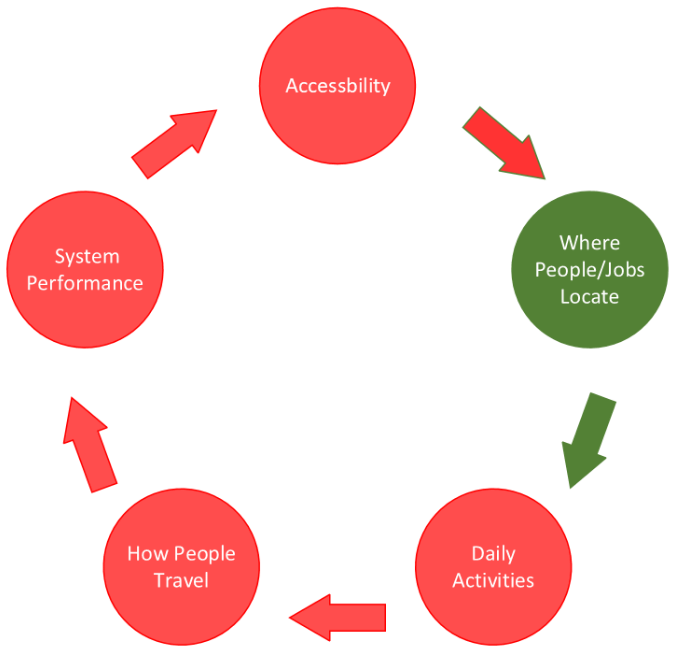
The urban-access and development loop. From “How Transportation Model Interacts with Land Use Model” slide Met Council Transportation Modeling Transportation Committee December 2023.
LTM Part I strives to explain that the formal cause of systems (ecologies) is in their feedbacks. The diagram above shows the general feedback loop of the urban access form. Feedbacks are loops and each segment of the loop is just someone acting efficiently. The node “how people travel” might be broken into another loop of mode choice by people and how the State responds to that by projects. The political decision to “satisfy predicted traffic growth by more capacity” is the key formal change for the AOS. But at any level people act in the “circumstance” of the loop and not on changing the loop. If we do not change the loop form we are going to keep wondering why it is so uphill to get TOD back (again). Why is it so hard to get back what once worked so well?
There is however resistance to re-linking TOD location to its rail mode [Sam Stevenson, California Cities Threaten To Sue High Speed Rail, Newsweek, May 14, 2026]:
Nine California mayors have warned that they could sue the state’s High-Speed Rail Authority if it was to implement possible plans to capture local tax growth and zoning control within a half-mile radius of future station sites. Escalating legal threats could complicate efforts to fund and deliver a long-delayed rail project already facing financial pressure.
Financial pressure: The AOS has spatially extended all infrastructure, straining all public finance except the Federal that just increases the deficit spread over all our taxes. We are in a corner where there is political resistance to making even a small finance loop for TOD. The national opposition even to the Transit Trust Fund is the larger version of this bias against doing for TOD what the Highway Trust Funds (both Federal and several-State) did for the AOS. Hysteresis. We built so much highway we cannot now afford not to fund more of it whether for maintenance or expansion.
At the individual level, hysteresis applies to trying to get people to change mode once their behavior has adapted to a mode within its access form [Why Good Alternatives Still Can’t Get People Out of Their Cars, Transport Leader May 7]:
Key Takeaways:
People choose the transport mode that feels most desirable to them, not necessarily the one that others might consider objectively the best.
Investing in a new public transport option only produces mode shift from cars if it clears the desirability bar set by the car…
Even when public transport genuinely improves, habitual car users may not notice or believe it, which is why behaviour change programmes matter, but only once the product is good enough.
Metro lines that appear to produce modest mode shift at opening may prove transformative over decades, but only if land use policy encourages dense, transit-oriented development around stations.
This is all about efficient behavior by people and how formal change is about feedbacks and “long term”. We can jawbone about why it should be different or prop-up transit by straining public budgets already strained by AOS infrastructure expense. LTM says: Look for the formal change in the access feedback and fix that to how it was prte-1920. Turn the hill around. No, not easy and it is political.
How to put it back into the Tube
The Transport Leader Newsletter goes further to describe the formal constraints imposed by a century of AOS:
The politically unpalatable truth that the desirability line framework makes plain is that in cities where driving is deeply entrenched, supported by decades of car-friendly infrastructure, abundant free parking, and cultural norms built around the car, no amount of carrots is likely to close the gap…To achieve meaningful mode shift in these cities, you need to reduce the desirability of driving. You need sticks. Sticks come in various forms. Congestion charges, parking charges, and reduced parking spaces…
Changing the urban form back to TOD is a historical asymmetry of hysteresis. Suck up the freeway and the neighborhood does not just flow back. Take away the freeway and even if a rail line is in its place it no longer has the same relation to places that sprawled because of the freeway.
The TOD itself went through the characteristic logistic profile of development. It had exponential growth when the “carrots” were the positive feedback loop of speculative finance of rail against the apparent influx of population around the places served by rail. That ended about 1905. Then the negative feedback dominated, the “sticks” of urban congestion and the modal shift from rail to automobile. Putting the toothpaste back in the tube has to restore the positive feedback, the “carrots” that induce the investment and location behavior.
Much has been assumed about the desirability of TOD but only in reaction to automobile costs and disillusionment about the suburbs that have experienced urban congestion as they develop: “The congestion just followed me out”. That is what makes the “stick” to the AOS an obvious strategy and politically difficult. Politicians like carrots but most voters are stuck in the AOS and want cheaper gas!
The TOD disappeared with the private-finance carrot of returns from growth when that was via rail and urban real estate. It was speculative because on an upswing the money is made from anticipation, not paying for what already exists. When the future becomes present we get “decaying infrastructure”. The bill was passed to urban taxpayers who were also the only source for the early highway projects. This just reinforces my emphasis on urban-regional governance to link resource control to what is already closest to TOD. The States simply preempt the needed carrots or sticks.
The statistics imply that there will be odd cases of TOD. The few urban regions with rail transit are TOD, a fossil of the last century. I was just in Manhattan, still choked with autos in places, but a density that makes transit use, and pedestrianism and bicycles, natural behavior. That it adopted the stick of congestion pricing is logical, efficient, and politically a statistical anomaly. But look for anywhere else that may happen (Boston?).
Hysteresis implies that people and politicians will only envisage Little Uphill Moves. The statistical anomalies are the “fluctuations” that might self-organize a new TOD form if they form a feedback loop. I am all for any such efforts in the name of TOD. They just are not re-forming TOD in the US. We need to understand the power of the earlier formal change from TOD, a century back now, to appreciate the power needed for going “backwards” in the hysteresis loop. LTM just leaves open the need for regional governance to break State preemption. That would be a powerful, constitutional change.
We might have an awful hope for “giant asteroid” as an external stick to make us change. Peak oil? Global warming? Nope, not yet. Beside the little uphill moves we need to think about formal change and that is what LTM is about. Look for how to change the feedbacks at regional, State and national scale.