
Open Wiiiide!
The Consumption Conspiracy between highway engineers and the consumers of urban space goes on

The Highway Battles Go On
My fellow Substacker Billy Cooney [flâneurbanist, Jan. 19, 2026] got my attention on one of the main topics of Limits to Mobility (LTM):
What Texas DOT is doing in Houston—demolishing homes, businesses, and schools to widen a highway to 22 lanes—seems mad, but to an engineer, it’s simple: we widen the road when congestion increases. Simple logic for a simple worldview. It is logic devoid of everything else.
The project by the Texas State Highway Agency (SHA, although they call themselves a “transportation” department) is “Segment 3” of the North Houston Highway Improvement Project (NHHIP):
The North Houston Highway Improvement Project (NHHIP) is a planned reconstruction of I-45N, between Houston’s downtown and the North Sam Houston Tollway, also known as Beltway 8, that includes segments of connecting freeways.This project will improve I-45 from Beltway 8 to I-10, and reroute I-45 through the downtown Houston area along I-10 and US 59/I-69. Portions of I-10 and US 59/I-69 will be improved as well.
The “Key features of segment 3” include:
Widened I-69: Lanes will increase from 8 to 10 or 12 in each direction to accommodate traffic demands.
Express Lanes: Two new express lanes in each direction will facilitate through-traffic downtown.
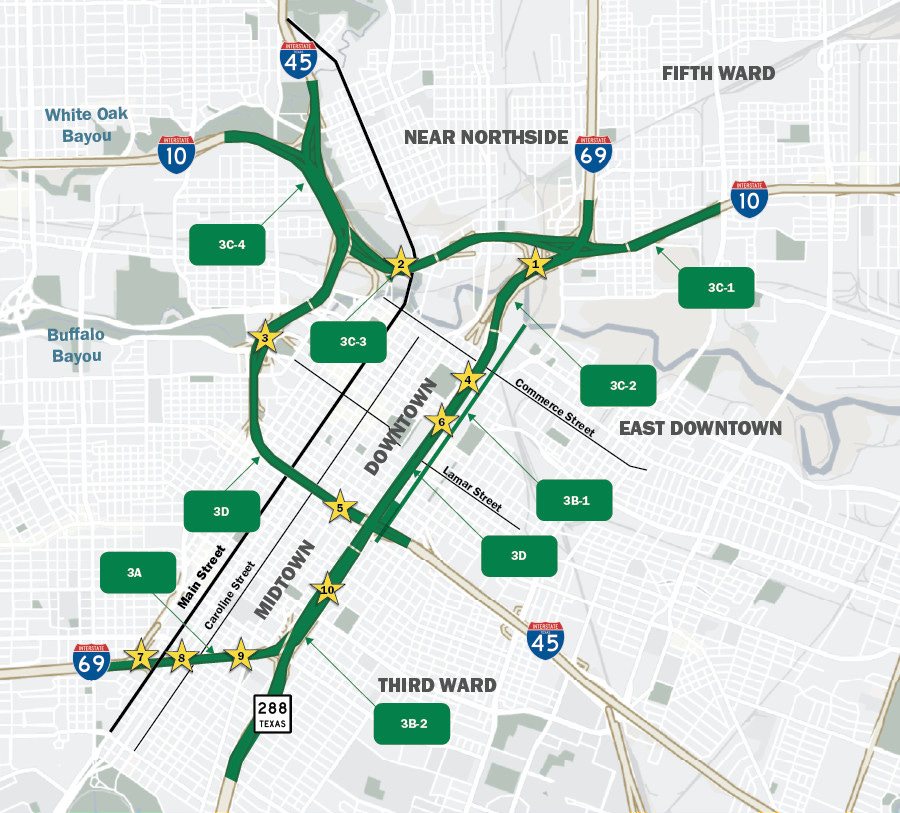
I-69 being widened up to 12 lanes through Houston. Even DC kept such widenings ca. 2008 to the Beltway rather than slicing through downtown.
LTM has been drafted over the last 50 years starting with my part of the highway revolt in Troy, NY and elsewhere. Since I saw the New York SHA demolish a strip of Troy in 1969 for a highway that was never built, perhaps my outrage is understandable. That was just the dawning of a battle against them pushing an 8-lane bridge into what had been a 4-lane urban arterial. I read in the news just today about a pedestrian struck on that now-overloaded arterial and the usual huffing about the need for “safety improvements”. Who ya gonna call? The agency that created the problem?
I reach far back in LTM and these posts (back to 1893-1920 at least) to get at where we are now in this absurd process of demolishing more urban development to concentrate auto traffic where it does not fit. We did a compilation of such projects way back about 1980. I recently deposited the letter files of those project battles with the Transportation Library at Northwestern University. The continuation of the process does not surprise me. U.S. PIRG has carried on the work of identifying current Highway Boondoggles.
Why why Widen?
I have continued to present a systems view of our urban ecology. What develops has a positive feedback, until it hits limits and a negative feedback that brings it to a mature (but usually unstable) stature. Limits to mobility produce urban places. Highways override urban places as limits to auto traffic. The former rail transport of transit oriented development (TOD) had much higher limits and so the concentrated urban places we used to have before auto-oriented sprawl (AOS). There is nothing complicated here folks, but the resultant urban ecology is complex.
The change from TOD to AOS was a formal change, marked by a change in the feedbacks. OK, I have said that repeatedly and I am just taking the opportunity here to use the Texas project (and all its concurrent Boondoggles) to reiterate what is going on.
The feedback of traffic→capacity→traffic persists through the institutional power and funding of the SHAs. The SHAs (the official label in Federal law) are the manifold tentacles of the Federal-aid highway program. How that came about is detailed in the history of LTM Part II. That history has to go back to 1893 and beyond. The technical process is covered in LTM Part III. That goes back to ca. 1920 when auto traffic expropriated the original Rural Good Roads program and a Federal-aid highway system was defined that inevitably supplanted the rail system, right through the urban centers. The doctrine of sacrificing urban development was only codified in 1939, enacted in 1944 and power-funded in 1956. BTW, if you tap my article links you will be led to the further source references.
The effect of the Federal-aid program was to detach the SHAs into their own political-money power centers. They were given the power over metropolitan development by creation of the Metropolitan Planning Organizations (MPO) in the 1962 Highway Act. We have the sequence of proposing the urban-lacing highways from 1939 (or latent in 1920) and get around to the “planning” later. But the MPO plans no regions, it programs the highway funding authorized in 1944 and mapped by the SHAs from then until the post-1956 construction.
We come around to the 1960’s and 1970’s and, lo and behold, how can you possibly resist this project we have been hatching for X years. In the case of my Bridge project whose first Environmental Impact Statement (EIS) was in 1972, reference was back to the SHA’s 1954 Arterial Study that in turn was in sequence with all the studies after 1944. Layout the highways, then think about the impacts much later. The EIS was so bad even USDOT made them do it over.
It happened that the Albany study was in 1950. That mapped what was to be I-787 on the 1955 Yellow Book maps of the nationally-collected projects for the 1956 Act. I-787 across the Hudson from Troy of course required access from Troy, hence that 8-lane bridge. Oh, there was another existing bridge that the SHA just ignored (not on the 90% Federally funded system, don’t ya know). Oh wait, that bridge fell down in a 1977 flood and got 100% Federal emergency funding. Whoa, see the SHA engineers fly! But hey, keep doing the other bridge since the real reason was never Troy access, but overriding Troy on a new alignment of NY Route 7. I even got to confront the Secretary of Transportation (Drew Lewis) at the time and all he could see was the through-route to Vermont (he had used). What was a Troy neighborhood became a barrier between downtown and “North-Central” Troy, the new area of slum migration.
Wider Wilkins!
This is the bottleneck chain effect, my main answer to “why we HAVE to widen”. Or bottleneck whack-a-mole. You’ve got yer traffic network, see. No one is accountable for that. It is too complex. It self-organizes. The gummint agencies each get a little part to focus on, and the SHAs are Big institutions for all their little parts, the hundreds of projects (a few of which are urban widenings) across a State. How do we define these projects? Look for the bottlenecks and whack em. Oh, there comes another…
The process of identifying the bottlenecks could be purely empirical: Look for where they are. Cripes, the TV News chopper remarks on them every day. But I like looking into the technical process of traffic prediction and evaluation by the Level of Service (LOS) criteria. Oh yes, all very technical, in the computer. Not for you laymen and stupid highway NIMBYs. The SHA convinces itself that the traffic cannot be impeded here and there, so program a project. You, Wilkins, Highway Engineering PE, design that added capacity! (Maybe not Wilkins, but that alliterates, apologies to any Wilkinses).
That got my dander up in the 1970s, me being a systems engineer and all. So I studied the whole process, particularly how traffic was predicted. There is great detail on that in LTM III and Prediction Needs Regulation (that is actually about Asimov’s conceits about galactic prediction).
The idea of predicting traffic growth goes back to the 1920’s when the highway engineers faced the problem of traffic-limiting highway capacity—bottlenecks—apart from the prior road-surface quality and geometry. But in the 1950’s fancy computer network-analyses were undertaken and became de rigeur in the MPOs. Got the technology? Use it. Think what AI can do for us now.
From the 1920’s through all the projects out of the 1944 Act and into the 1955 Yellow Book maps, there were no computer network analyses, just pencil and calculator (kachung, kachung). That is no criticism because the computers did not really add that much to the fallacy of predicting what you will change anyway (which gets to what Asimov was discussing as SciFi in his Foundation series).
The key here is less the prediction than what the highway engineers do. They draw lines through the cities (not too many, but many more than were actually built) and that is where they concentrate the traffic. Much less road mileage and intensity was laid out than what self-organized of course. The urban development process lacked the highway engineers and money until WE the SHA came along. Le Ville ce Moi!
The lines—drawn ca. 1944-1955—defined just where the future bottlenecks would be. It is where the highway engineers put the concentrated traffic. And once the initial phase of capacity was built (the 1956 program was supposed to be done by 1972) guess what? Hey, no cheating by asking ChatGPT! Answer: The last generation of concentrated-capacity defined the new generation of bottlenecks. Wilkins, come here!
Loop de Loop
As I said, this is a feedback loop of traffic→capacity→traffic. It may be called “induced traffic”. That is good enough for the apparent effect but the system loops involved are wider. That is why I talk about the formal urban-ecology change from TOD to AOS. We have to get into the self-organizing theories of urban development, that did not come along until the latter 1970’s (see LTM). There was an important article on the feedback and prediction in 1978 [R J Bennett, Forecasting in Urban and Regional Planning Closed Loops: The Examples of Road and Air Traffic Forecasts, 1978]. Through the development of the TRANSIMS network model in the 1990’s there had been debate even within the profession about the ill-handling of the feedbacks. The basic limitation of predicting a little and then correcting for the new bottlenecks goes on. The modelers just say “things change”.
Insanity is the expectation that doing the same will have a different outcome. The SHAs do not admit to that. They are just doing their jobs. Build a little, then build a little more. A 12-lane expressway (now with HOT lanes!) through a city is not absurd, unless you go back to the original mission of just demolishing what is in the way of the traffic YOU concentrated there.
I like to pose this process as focal efficiency that ignores the formal change that should be what our government attends to. You either accept that analysis or believe that engineers (with Computers! Not you stupid NIMBYs) should keep altering the urban ecology, and so the whole ecology, all the way to the oil fields of Venezuela and the lithium fields of…Greenland? Oh, but that is not my tiny, tiny responsibility. No, Wilkins just takes the predicted traffic, applies the LOS analysis from the Highway Capacity Manual and voila, we get the lanes we need! I said NEED! The traffic flow Must be Efficient! All that matters is the Time Saved by automobile users, because the traffic congestion keeps costing More Time. That is what the gummint can count! Ecological quality? No: That would be dozens of incommensurate measures, so who can evaluate that? A Level of Ecological Quality (LEQ)? Sorry, Wilkins has no PE in that.
LTM only strives to expose what the issues are and how we got that way. Absurd? The more absurd our gummint gets…[I have to misquote Shakespeare, Henry V];
If little faults proceeding on distemper
Shall not be winked at, how shall we stretch our eye
When [ecological] crimes, chewed, swallowed, and
digested,
Appear before us? We’ll yet enlarge [that freeway].
We have spent a century not caring about the fate of our urban form. And so on to the global ecological form. Why change now?
Thanks for that--I appreciate your comment and that is what LTM is all about.
Strong breakdown of the feedback loop. The bottleneck whack-a-mole analogy is perfect, its exactly what I've seen play out with the highway expansions in my area over last decade. They widen one section, congestion just moves downstream, then another widening project gets proposed. The institutional momentum behind state highway agencies really is remarkable, seems like theres zero accountability for the induced demand they create.