
Build Auto Oriented Sprawl, some more
Why Congress takes a thousand pages to continue disruption of the urban ecology

New/Old Surface Transportation Bill
I have tended to stay away from close analysis of the Federal transport bills since my days in the Intelligent Transportation System (ITS) program, 1996-2002. Before that I did legislative analysis (New York State and Federal) and environmental impact statement (EIS) sharpshooting on particular highway projects. Conversely I have advocated rail transit projects, including a restoration of passenger rail to connect Troy to Albany, NY on still-existing track. Lost that service in 1958 [see “Rail Station or Parking”].
I am breaking my own rule after reading Jarah Jacquay [Washington is Creating the Most Expensive Traffic Jam in the World: “That isn’t conservatism. It’s debt-financed dependency with a flag decal.” StreetsblogUSA, June 3, 2026] and then scanning the referenced AMENDMENT that aspires to become the…‘‘Building Unrivaled Infrastructure and Long-term Development for America’s 250th Act’’ or the ‘‘BUILD America 250 Act’’.
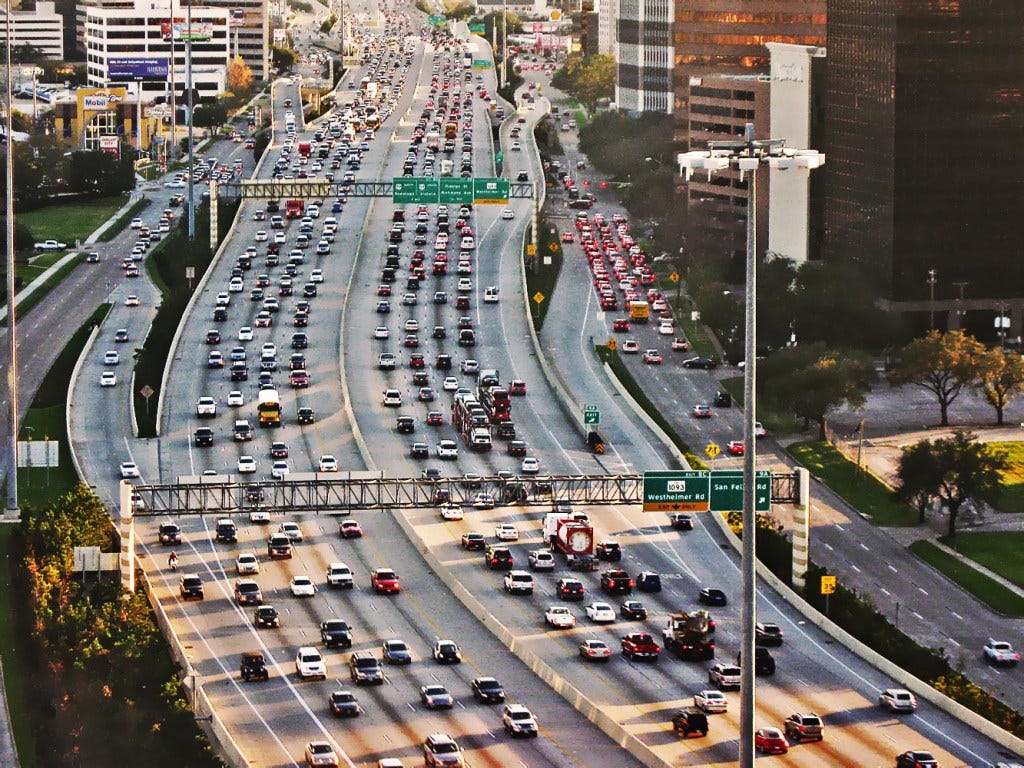
Auto-oriented sprawl, at public expense and congestion. Photo: Wikimedia Commons via StreetsblogUSA
Brookings has its own comment and critique on the BUILD America 250 Act [Adie Tomer and Ben Swedberg, The BUILD America 250 Act: What Congress gets right and wrong in its new transportation bill, Brookings, June 2, 2026]:
Since the Interstate Highway System was effectively completed and the modern surface transportation era began in 1991, Congress has steadily added new components to formula grant programs…The BUILD Act would begin to reverse that approach. The bill effectively pairs a reduced congressional vision with greater state autonomy. States receive a larger share of total funding via highway formula programs, and the dollars are made more flexible by expanding qualified expenses and transferability between programs.
…The lack of forward-looking vision, however, becomes clearer by looking at what the BUILD Act cuts. The bill would reduce relative spending on transit, eliminate guaranteed funding for passenger rail, disincentivize the transition to electric vehicles, and generally commit fewer resources to consumer choice. It cuts formula programs focused on environmental resilience and reduced pollution.
I would just differ to state that the “modern era” started with the 1978 Surface Transportation Act that was the first response to both the Highway Revolt and Decaying Infrastructure. The decay was after two decades of the massive highway spending and the “Highway Trust Fund” of the 1956 Highway and Revenue Acts. The Federal highway acts go back to at least the 1916 Federal Aid Road Act. Before 1978 it was much like now: Isn’t building highways wonderful…See the USA in your Chevrolet!
The Act draft being reviewed is still just a proposal but coming from the House Committee and its Chairman, Sam Graves (R-MO)—that is him promoting himself below— will represent many of the provisions to be approved as a final Act.


The Thousand Page “Amendment”
The House committee bill under review consists of 1,006 pages. It amends the existing law created in 1956 since changed and codified in 23 USC (Volume 23 of the U.S. Code on Highways). So all the words in the 1,006 pages are not even the full Federal law affecting transport programs—hence the form of all urban development in the US—but rather a sort of picking and poking at it. Of course the House has to authorize the funding of anything (however Trump may quibble with that) and so the most important amendments are the particular funding amounts authorized for programs. Of those the major items in the current Amendment are, for highways:
Title I, FEDERAL-AID HIGHWAYS: SEC. 1101. AUTHORIZATION OF APPROPRIATIONS:
A) $56,934,650,000 for fiscal year 2027;
(B) $57,532,010,000 for fiscal year 2028;
(C) $58,690,676,200 for fiscal year 2029;
(D) $59,785,644,724 for fiscal year 2030;
(E) $60,943,911,618 for fiscal year 2031
These are the major highway amounts (billions and billions!) allocated to various programs (there are 9 major highway program categories allocated parts of the total as of the 2024 FHWA tabulation). These funds are granted primarily to State Highway Administrations (SHA). The SHAs are the unelected agencies who gained political power via their control of the project money. They carry the eminent domain power that preempts any local sovereignty, and pretty much dictates to State legislatures.
In addition are the relatively small, always-separate funds directly administered by the Federal Highway Administration (FHWA) for Federal lands, tribal lands and our colonies (aka Pacific Islands). The proposed amounts for public transportation (meaning transit, some on rail but not private autos on public roads) are:
TITLE III—PUBLIC TRANSPORTATION: Sec. 3023. Authorizations
(A) $16,868,000,000 for fiscal year 2027;
(B) $17,205,000,000 for fiscal year 2028;
(C) $17,527,000,000 for fiscal year 2029;
(D) $17,835,000,000 for fiscal year21 2030;
(E) $18,157,000,000 for fiscal year 2031.
I find it interesting that the highway funds are listed at the top of Title I before the other 37 sections of specification. Title III for Public Transportation has 22 sections telling what is to be done with the funding before getting to the amounts granted. Is that like chastising transit agencies before holding out the money? Here are some obvious comments on the dollar amounts
The Public Transportation authorizations are about 30% of the highway authorizations.
The Federal highway funding is still only about 17% of total highway funding by all subordinate government levels (as of 2024 from Highway Statistics, FHWA). The 2024 total (including State and local funding) of $332 billion allocates $159B to capital expense and $78B to “maintenance and services”.
The 2024 transit total expenditures are $27.6 B capital and $61.5 B operating (2025 APTA Fact Book). The Amendment is then contributing only about 19% to that. Federal capital support is greater than what the States provide.
AMTRAK—our measly network that replaces what we lost in 1920 at rail peak mileage—has its own provisions. Title X, SEC. 10101. GRANTS TO AMTRAK has:
For the Northeast Corridor for fiscal year 2027, $1,950,000,000.
For the National Network for fiscal year 2027, $3,900,000,000.
And so on with increments for subsequent years. How much do they care for intercity rail? That is in the ratio 10:1 against highways. There are further provisions for oversight and efficiency to keep AMTRAK limping along. Must be efficient! Not like all that rural road mileage that makes no financial sense but is is welfare for rural projects.
The relative amounts for the Northeast Corridor and “the rest” are a good indication of what might have been left to the urbanized northeast to retain their transit-oriented urban form, and what it could do now if they had complete control of all the money otherwise under Federal dictate. The rest of the country just gets a thin spread of Federal redistribution, the original genius of Federal Road aid.
Beyond the Handout
As Limits to Mobility (LTM) strives to point out, Federal legislation since 1893 (the first Federal road-agency authorization) has steered national transport policy and thereby the form of the urban ecology. That form is access (the relative spatial distribution of locations). After 1920 —with declaration of a National Highway System, and failure to do anything for the rail modes in crisis—Federal policy changed the dynamics of development from transit-oriented development (TOD) to auto-oriented sprawl (AOS).
Highway projects through the unelected SHAs, and then with a nod from Metropolitan Planning Organizations (MPOs) after 1962, have never been accountable for the modal and access changes. By the 1970’s we had a gas crisis from our AOS, a financial crisis of the private bus operations that replaced rail transit, and the “decaying infrastructure”, by which they mostly meant decay of the expanding highway system States went into debt to build and then could not afford to maintain.
While LTM focuses on 1920 as the critical year of decision—and the Federal failure to manage its own economy—the Surface Transportation Act of 1978 is a second critical point. The highway system further elaborated by the “Interstate Highway System” in 1944 [an extensive history of all this is in LTM Part II] and unleashed in 1956 was supposed to do wonders for us all, and be done and dusted by 1972. It rather became a primary casestudy of the failure of government to manage our risk and equity (and LTM argues that equitable risk management is all government is supposed to do). After wide revolt against the 1944-56 highway scheme and all else in the 1970’s there should have been a heavy rethink of the entire highway program.
There was no Federal funding of transit until 1962 and nothing substantial until 1964. Federal action was also split initially between transit’s association with housing and the longstanding Federal-State alliance via the FHWA and the engineer’s sit-down in the American Association of State Highway Officials (AASHO).
The Highway Revolt led to the 1973 Highway Act that first posed some cross-modal possibility by the “tradein” option for non-essential Interstate segments for alternative projects (some transit, but also highways). That there were any non-essential segments is testament to the uncontrolled and unaccountable exploits of the SHAs. I like to repeat the experience of Troy with the arterial highway that the SHA demolished a neighborhood for, then never built. While I was a transit planner in Cleveland I also found the map of how the SHA would have rammed highways all over that place (right through Shaker Lakes!) and similarly for DC. Oh dear. Unlimited power to destroy urban centers and then leave the public a capital structure that was congested and unsupportable. And yet the SHAs are still saying: “Just a little wiiider!” Of course they need to build that little link to the new development or shopping mall that extends sprawl.
The 1978 Surface Transportation Act (STA) co-opted transit into the kind of highway bill that BUILD America 250 still is, after a series of equally clever acronym bills (ah, ISTEA I think of every summer). Before 1978 separate transit authorizations would be used by urban legislators in horse-trading with the highway proponents. The STA put the modes in one bill with the tendency to co-opt the transit advocates with an “approve it or lose it” proposition. Same when the Federal highway money drops on a locality. Free money! Don’t turn it down!
Alright, we now have the primary statement by BUILD America 250 that the Federal government cares about 5:1 highways to transit. Well, buses run on highways, therefore better highways mean better transit, right?
What we have is the self-licking ice cream cone of the AOS. We killed rail so, yes highways are the only way around. We got a lot of highways and highway traffic, so we have to do something about what we have, never mind any future ecology. Ooomph..more money! Oh some crocodile tears are shed for the inequity of who cannot get in a car and drive around, or choose not to, that is the 5% or so of urban tripmakers. Under Title III (for transit) we have Sec. 3001 declaring policy:
§5301. Purpose and declaration of policy
‘‘(a) GENERAL PURPOSE.—The purpose of this chapter is to foster the delivery of safe, high-quality transit services by public transportation providers to individuals, including individuals with disabilities, seniors, and individuals who depend on public transportation, including through Federal funding to public transportation systems.
Yes, that gets back to when I got into transit planning in the early 1970’s when the Feds funded major demonstration programs to give mobility to the “young, aged, handicapped, poor and unemployed”, the YAHPU population. Oh, the AOS left people without mobility? This was a three-part problem: People who had a hard time getting out in any case; people who lost transit service and did not gain auto service, and; the sprawl of services away from any modal access other than autos. The first part of that was not unique to the AOS, but it was a problem of equity. BUILD America 250 just repeats the problem and its formal cause, that 5:1 funding of highway over transit and indifference to sprawl. More of same, and tears of guilt. But not for the TOD.
Access and TOD
These articles and LTM assert that TOD is dead. It just persists zombie-like. Some people want TOD. Planners advocate TOD. Projects that concentrate transit service—even rail!—and then with concentrated housing and commercial locations do, sometimes, occur. I am saying that before 1920 the finance of development and rail was the inherent financial dynamic of urban growth. Now it is at some public-sector discretion and that discretion is roughly 5:1 against. We argue about the expense of transit that is underutilized (the self-fulfilling policy of AOS) and then about interfering with the real estate market, or local zoning rooted in the AOS.
BUILD America 250 does have some things to say about TOD, much like it has something to say about the “individuals with disabilities, seniors, and individuals who depend on public transportation”. TOD occurs in two sections, and in the latter is renamed transportation-oriented development (oh wait, all development is…).
Sec. 3004 of Title III:
c) TRANSFER OF PROGRAM FOR TRANSIT-ORIENTED DEVELOPMENT PLANNING.—Subsection (b) of section 20005 of MAP–21 (49 U.S.C. 5303 note), as amended, is transferred to appear as subsection (i) of section 5305 of title 49, United States Code.
Title 49 is “Transportation” as opposed to Title 23 “Highways”. Title 49 covers transit and urban planning. The change is to take TOD out of the Metropolitan Planning section into State Planning.
The second reference to TOD in BUILD America 250 is in Title X (Rail), Sec. 10506. Direct loans and loan guarantees:
Section 22401 of title 49, United States Code, is amended by adding at the end the following definition of TOD:
(16) TRANSPORTATION-ORIENTED DEVELOPMENT PROJECT.—The term ‘transportation-oriented development project’ means a project—
‘‘(A) located within 1⁄2 mile walking distance of a fixed guideway transit facility, bus rapid transit facility, passenger rail station, or multimodal facility provided that the location includes service by a passenger railroad;
‘‘(B) that consists entirely of or includes residential, commercial, public infrastructure, or mixed-use development or other related infrastructure, including public or community space;
‘‘(C) that incorporates private investment
(D) that—
‘‘(i) enhances the effectiveness of passenger rail transportation and is related physically or functionally to passenger rail service; or
‘‘(ii) establishes new or enhanced coordination between passenger rail transportation and other transportation;
‘‘(E) for which the project sponsor demonstrates the ability to generate new revenue for the relevant passenger rail station, facility,or service, including by increasing ridership, increasing tenant lease payments, providing a fair share of revenue that will be used for passenger rail transportation, or carrying out other activities that generate revenue exceeding costs…
The definition is interesting: It now makes distinct, for Federal funding purposes, what was the self-organization in the “free market” of the urban access form. In other words the government now defines the market it distorts. In the old TOD funding was not scattered to the hinterlands and real estate investment was synergistic with rail access (sometimes the same agents investing in both parts of access). How much “planning”, State or metropolitan goes into the “new State-approved TOD” remains to be seen but the funding ratios for the modes tells its own 5:1 story. Maybe those are the odds of any urban jurisdiction seeing TOD (as defined) ever again. In four cases out of five (for smaller urban areas like Troy) the highway program will continue to make TOD impossible.
Streamlining the AOS
I already wrote about Streamlining the death of TOD and Streamlining Abundance. BUILD America 250 has Title I (Highways) Subtitle B—Improved Project Delivery and Environmental Streamlining. To be fair I mention Title III (Transit) Sec. 3007 to streamline projects for existing fixed guideway transit (rail).
The TOD is the halcyon period of just BUILD-ing without all that “environmental review” crap that actually started in highway regulation in 1968 after doing so much social, economic and environmental damage, and then in the National Environment Policy Act (NEPA) of 1969. We got the environmental impact statement (EIS) for Federal projects, its multi-agency review and pot-shotting by people like me. The net result was that some really shoddy EISs were forced to improve but very little judicial traction to affect agencies and projects whose mission was not to improve anything but traffic flow to begin with. Concern for the integrated ecology meets siloed projects. See LTM Part III for more about all that.
Since 1970 then—and remember that is the era when the whole paradigm of siloed Federal-State projects on cities and countryside lost its glow—any mis-management of projects had something else to blame besides programming, budgeting, engineering and whatever political stuff survives the money avalanche of Federal-aid projects. On no, it was the time taken on that cursed EIS that was the problem! Sort of like blaming the traffic congestion the AOS created on all that “lost time” (can Proust find it again?)
The problem of doing “right” projects is as much confused as decaying infrastructure and why we still need a Federal Act, with 1,006 pages just of “amendments” to “help” us get better. My experience is that the SHAs just programmed their post-1944 highway diagrams as money came along, with due attention to the traffic bottleneck the last projects created and the sprawl-traffic induced. The time needed to think how the project then fit into an increasingly distorted, depleted and polluted urban form was concurrent with the time to get together an actual engineering design and contracts and stuff. Unless the engineering design had not considered the ecology at all to begin with the EIS should not have been in the critical path. Do we have data on how much stupid expense EISs saved? Let me tell you again about that arterial in Troy that demolished a neighborhood just before the EIS requirement, and then was not built. Or all the unnecessary ramps to the Hoosick Street Bridge. Or the Albany ramp to I-787 that was later decommissioned, and the urban freeways now being unbuilt… Ooopsy.
Streamlining like “decaying infrastructure” is an avoidance of accountability for real ecological problems. But that is what this Administration, and all its siloed projects is about.
Boasts and Roasts
BUILD America 250 shows what it is ‘agin and what it is for by its incremental changes to the Highway and Transportation law. The Committee’s own blurb has bipartisan statements on what they think the amended bill will do:
The BUILD America 250 Act emphasizes moving people, goods, and freight safely and efficiently across the country. The bill provides the largest ever investment in America’s bridges, focuses on proven surface transportation infrastructure programs, provides passenger rail investments and reforms, improves rail safety, ensures that transportation projects and programs are more efficient, encourages innovation, provides the first ever autonomous commercial motor vehicle framework, and injects the Highway Trust Fund with its first new stream of revenue in over three decades.
…cuts federal red tape, promotes transportation innovation and safety, allows states the flexibility to address their unique infrastructure challenges.
…creating good-paying transportation jobs, growing the economy and safely transporting people and goods across the country by road and rail.
…brings commonsense fundamentals back to the forefront, strengthening our roads, highways, and bridges while ensuring the strategic, responsible use of hard-earned taxpayer dollars to get even more projects delivered…
…enables critical investments in passenger rail, including making the Union Station Redevelopment Corporation eligible for five significant federal grant programs. It equips the Federal Motor Carrier Safety Administration with the tools needed to protect consumers from predatory household moving company fraud, and it makes ‘blue envelope’ programs, which improve interactions between police officers and drivers with difficulty communicating through speech during traffic stops, eligible for federal transportation grants for the first time.
…streamlines and reforms key programs that will help improve the safety, efficiency, and long-term reliability of our freight and passenger rail systems. It requires real accountability from Amtrak, strengthens oversight of America’s rail network, and eliminates wasteful grant programs and project spending to ensure taxpayer dollars are invested responsibly.
Whether those things are improvement is a matter of taste. If they are improvements then they better what nearly a century of Federal transport policy has led to, and that is not a promising track record.
These grandiose statements by Congresspersons indicate the high, pie-eyed level the legislators occupy. Of course The BUILD America 250 Act will be a renaissance for America: better, faster, stronger. Again? It is more like continuing to repeat the promises of 1956, as if that will make them true. There are some problems implicit in the statements, especially a failure to manage the Trust Fund adequately (not charging highway users enough). The statement on “investments in passenger rail” does stand out and is made by Eleanor Holmes Norton, from the quasi-State of DC and with particular urban interests. Good window dressing but not indicative of a preponderance of Committee interests. How would they feel about decongestion pricing?
The level of rhetoric at the Committee-member level reflects what goes on in the sausage machine of legislation. Back when I actually probed what happens, the chief staffer to the committee just rebuffed my critiques by saying he trusted his friends in the FHWA. How much lobbyists penetrate to that level is unclear. Federal staffers in the Executive (that also aggregates SHA interests through their joint organization AASHTO, adding T for Transportation) and Legislative staffers are the ones fine-toothing the bills. They create the camel that becomes the legislative option with rare alteration beyond that.
In a way the insider-staff is good as a semi-random mixing process of ideas compared to any Dictator, or even half a polarized Congress able to impose superficial and ideological biases. Aside from the obvious pork-barrel projects that is (find those that name a location). But it will never move off the established business-as-usual. Something crazy like NEPA, imposed on the heels of the decade of Silent Spring, is swallowed and digested. You just do not stop rolling the public-works pork barrel.
Buried in the Amendment are some of the current ideological targets for roasting and they stand out for their traceability to MAGA agenda. Among these are:
Title I: Sec. 1129. Registration fee on motor vehicles.
§ 182. Registration fee on motor vehicles
‘‘(a) IN GENERAL.—The Administrator of the Federal Highway Administration shall impose for each year the following registration fee amounts on the owner of a vehicle registered for operation by a State motor vehicle department:
‘‘(1) $130 for a covered electric vehicle.
‘‘(2) $35 for a covered plug-in hybrid vehicle
and…beginning in 2029, the Administrator shall biennially increase the amounts specified in subsection (a) by $5.
The “covered” just means what we generally mean by an EV or hybrid. Got to be specific: Don’t want to tax that diesel pickup because it has a battery!
Here we have a targeted Federal tax increase preempting however States might choose to incentivize, or not penalize, EVs. The issue of road-using EVs not paying into the Trust Fund via a gas tax is cogent, but in my view those internal-combustion, petroleum-dependent, fume-spewing vehicles pay nowhere near their share to the ecology. Rather there is talk—outside the Act—of relieving the non-EVs of their gas tax in light of the Trump-induced jump in gas price. Swell, encourage them and remove receipts from the fund for the authorization in the Act. That is an example of the one hand not knowing the other, but then that is typical of the siloed programs and ideological poles that are the Government.
The Congestion Mitigation and Air Quality (CMAQ) program is another case of the two hands. CMAQ was created by the 1991 transport act [PL 102-240, 105 Stat 1932, 1991] jocularly entitled the Intermodal Surface Transportation Efficiency Act (ISTEA). Its Sec. 1008 created the CMAQ (now 23 USC 149). CMAQ funded projects if it was determined “…that the project or program is likely to contribute to the attainment of a national ambient air quality standard;”. The proposed Act subtly manipulates the intent of CMAQ and includes:
Title I: SEC. 1118. CMAQ PROGRAM
SEC. 1118. CMAQ PROGRAM
(c) REPEALS.—Sections 11402 and 11406 of the Infrastructure Investment and Jobs Act (23 U.S.C. 149 note), and the items relating to such section in the table of contents under section 1(b) of such Act, are repealed.
The repealed sections of the IIJA (Biden’s bill, 2012) are in its Title I (highways), Subsection D: Climate Change. That is already a red flag and the two repealed sections are about reduction of emissions by trucks at ports and “Healthy Streets”. But there are a number of clauses in Sec. 1118 that shift the balance of what is already an ambiguous program. Are you CMAQing if you substitute electric rail transit and bicycles for highways and autos? Of course, that was the idea.
In practice the SHAs will claim that auto-traffic congestion increases air pollutants and violates the State Implementation Plans (SIPs) for achieving the National Ambient Air Quality Standards (NAAQS) set by the EPA. So watch my hands here…widening highways can be CMAQ!
The outcome goal is to meet thresholds of air pollutant dosage-risk, that the EPA is now manipulating, according to what the SHAs say will be effective in their well-worn process of predicting traffic and adding capacity intended to reduce congestion. Except for induced traffic and sprawl.
This whole self-licking circle is addressed in some of these articles [Open Wiiide] and LTM Part III. The BUILD America 250 Act in its Sec. 1118 variously puts more discretion in the USDOT Secretary of what CMAQ is all about and reinforces the SHA “it will be an effective project if it reduces auto congestion”. In short, CMAQ is smacked, but still is a money category for highways.
Another crazy idea from the IIJA (Biden! Bad!) is about resilience. In the proposed Act, Title I, SEC. 1112. SURFACE TRANSPORTATION BLOCK GRANT PROGRAM, mentions “resilience” regarding “a weather event or natural disaster”, but not “climate change” (Nein, nein!). And later:
LIMITATION ON PLANNING REQUIREMENTS.—
Nothing in this section requires a metropolitan planning organization or a State to develop a resilience improvement plan or to include a resilience improvement plan in a metropolitan transportation plan under section 134 or a long-range statewide transportation plan…
Nope, don’t think about resilience in any comprehensive or long-range way that might arrive at the formal change in climate due to—what? Traffic (however un-congested) emitting green house gases (GHG)? Later in the Freight Title, Sec. 7006, there is reference to “supply chain resilience” which means keep the traffic going and commerce growing.
It is of course a long way from climate change to any project accountability. That is the essence of the Tragedy of the Commons (TOTC). The accountability chain is already “mitigated” by how the CMAQ is used. GHG inventories add nothing to the process, but that requirement on SHAs has already been “mitigated” by regulatory withdrawal. What remains is SEC. 1104. APPORTIONMENT that strikes “the carbon reduction program” under [23 USC] section 175. Nope, don’t want that.
A Thousand Pages of What?
I have not completely traced all the amendments to 23 USC or 49 USC. The regulatory discretion needed to interpret the legislative changes are another whole layer and strictly under the Administration and its agencies. Want congestion tolls or a new rail tunnel? So sue them.
We are supposed to be against State Planning. The TOD had very little. It did have some regulation of the monopolistic railroads, after the 1887 Interstate Commerce Act. But that was the Government against corporations. After Citizens United corporate money regulates what the Government does. The entire history of Federal highway law invokes corporate (“highway lobby”) manipulation of Federal policy, as if highways are a public interest and rail not.
The projects that come from corporate lobbying via legislation to a highway corridor near you are by the State and so never subject to regulation like those nasty old railroad corporations. That is what the siloing means: The projects are allocated by legislation, do their thing and there is no further regulation of the integrated effects on the ecology, on equity, on urban development or even the economy. Of course there is nothing like the rebate and kickback scandals of the early railroads and monopolistic corporations. No, the Government just keeps giving the highway kickback to the monopolistic auto mode. All the problems that squirt out from this process are treated by separate silos—like a little money to transit—that never solve the problem the State created for itself long ago.
A Counterfactual
The Federal funding in The BUILD America 250 Act is but a fraction of what is spent publicly on transport. Since we have converted transit revenue to private expenses on auto traffic the total public expense on highways shrinks to minisculosity of all the money in that loop of traffic-sprawl-highways that keeps the AOS growing. And yet, all the attention to words in the 1,006 pages of the Act is just proof of how Congress thinks it controls the form of American infrastructure, hence our behavior and the economy. It has been the key element in AOS but then the Committee does not want to take credit for sprawl and the shrinking of modal choice. Declining urban centers? Sorry, not my prob, must be what the “market” wants. Breadlines comrade? Sorry…
Just suppose the whole Federal transport-program legislation exercise went away. There would be no automatic return to status quo ante, or the TOD. Another article pointed out the hysteresis in our development path: What happens forward in time from 1920 cannot just be reversed instantly.
But suppose that all the Federal re-routing of funds and stipulations on use ended, leaving the revenues in the States they come from…
There are then two problems: One is the spatial inequity among the several States measured by tax revenues per capita, per area, or per highway mile. That is what the original Federal-aid Road Act tried to address, Robin-Hood like, by taking from the rich urbanized States and giving to the rural poor that were in the south and arid west. OK—so those became the Sunbelt States that drained people and commerce from the TOD States. The equity problem has reversed.
The second problem is that the underlying inequity is urban-rural, not State to State. The States as conduits for the highway funding bias redistribution to the rural areas, as they originally did before the Federal funding. I showed that biased effect even in New York State. States preempt the options of the urban regions to keep or re-develop their TOD. This problem cannot be solved without a constitutional restructuring of urban-regional jurisdictions. And without that we lose the economic efficiency the TOD had, despite the claims that spreading highways and sprawl is a better economic policy. That is just bad State Planning.
The Federal transport legislations are State Planning, just not good planning but maintaining project and modal silos. In 1920 the original Federal-aid idea of fiscal redistribution—that is not bad regarding equity but never claimed to be about efficiency—was altered to replace the TOD by the national highway system. That is the mistake that needs to be reversed. Hysteresis just requires that we start where we are. Fine. Maintain the roads we have but rebuild a rail-city ecology and economy. That is not what BUILD America 250 Act does. Rather it is part of the long un-building of what we had.